

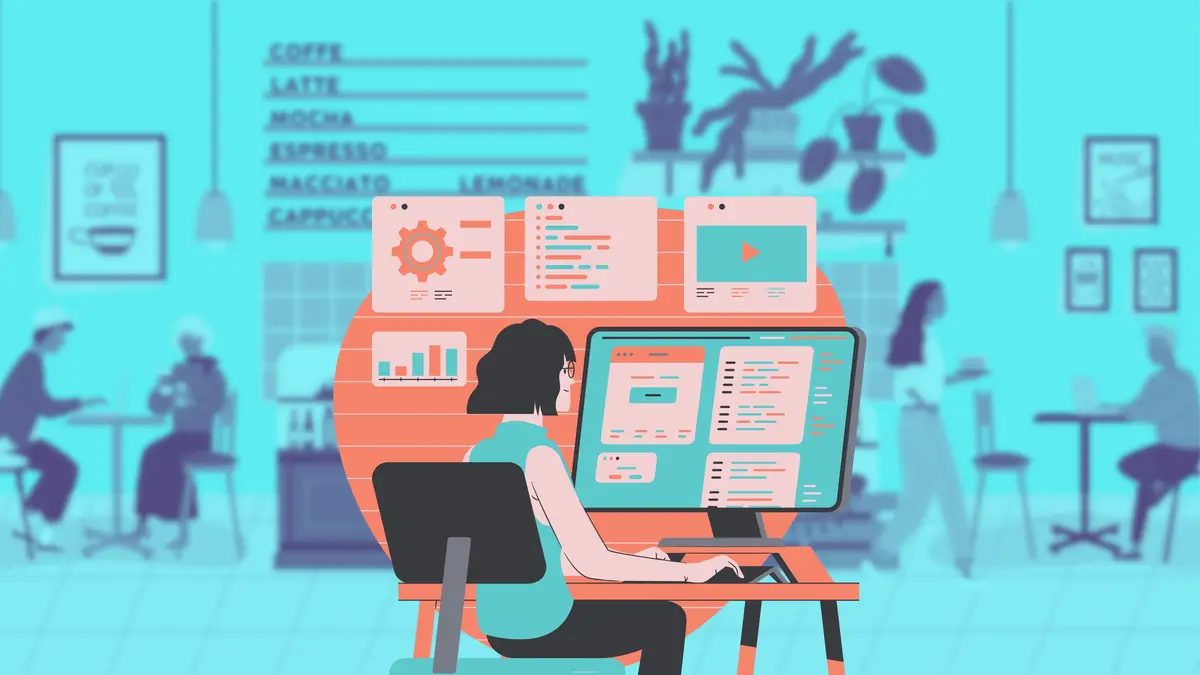
Post-pandemic, working from cafes (WFC) has become a global norm. Cafes are no longer just social hubs; they are secondary workspaces where people spend hours glued to their laptops. While most of us grab a coffee, open a laptop, and maybe order a pastry to justify our stay, some take the concept of a “mobile office” to a whole new level.
But recently, a quirky behavior among cafe-goers has left business owners utterly bewildered.
Imagine sitting down to enjoy your latte, only for the person next to you to unpack a full desktop setup—complete with a dual monitor, a portable printer, and a power strip. It sounds like a comedy sketch, but in South Korea, this is a very real, highly controversial reality.
Lately, cafes in South Korea have turned into a battleground between casual coffee drinkers and those looking for a free office. This phenomenon is known as “cagongjok” (카공족), which translates to the “cafe study tribe”—and they have become a permanent fixture in Seoul’s bustling coffee shops.
The “Second Office” Trend
The cafe scene in South Korea is unlike any other. Step into almost any coffee shop, and you will find patrons sitting alone at four-person tables, wearing noise-canceling headphones, and completely absorbed in their work. The term cagongjok is a portmanteau of ka (cafe), gong (study), and jok (tribe).
While the habit of studying or working in cafes is also common in places like Indonesia, where cafes have shifted from spaces for socializing and chatting to quiet study hubs, South Korea has taken this trend to a mind-boggling extreme.
“You can just go and have a cup of coffee, work there. But people are taking it a little bit to the extreme nowadays,” said Jo Elfving-Hwang, an associate professor of Korean Studies at Curtin University, in an interview with Fortune.
This extreme workspace culture has pushed food and beverage owners to their limits. In August 2025, Starbucks Korea made headlines by banning customers from bringing in bulky office equipment, including desktop computers, printers, and multi-plug power strips, across all of its 2,050 outlets nationwide.
The drastic measure was prompted by customers who took things too far—some went as far as bringing portable printers, secondary monitors, and even desk dividers to set up their own private cubicles inside crowded cafes. By enforcing this policy, Starbucks aims to preserve a communal and relaxed atmosphere, pushing back against the aggressive “cagong” culture.
Why Has Cagongjok Become So Popular?
Several factors have caused this phenomenon to go booming in South Korea. First, housing conditions in major cities like Seoul are often cramped and unconducive to productivity. Many young remote workers and students live in tiny “one-room” apartments where noise and lack of space make it impossible to focus.
Furthermore, affordable public workspaces are scarce. Public libraries are often overcrowded or have limited operating hours, while co-working spaces are prohibitively expensive. Cafes, on the other hand, offer free high-speed Wi-Fi, air conditioning, pleasant background music, and easy access to food and drinks.
This is compounded by South Korea’s hyper-competitive academic and corporate environment. The immense pressure to perform drives people to seek out highly structured, focus-inducing environments—even if it means colonizing a local coffee shop.
A Double-Edged Sword for Cafe Owners
From a business perspective, the cagongjok are not entirely bad. They provide a steady stream of revenue, especially during off-peak hours when cafes would otherwise be empty. Some establishments have even embraced them by installing individual study desks with built-in power outlets.
However, the trend has also given rise to what locals call “cafe villains.” These are patrons who take advantage of the system by bringing excessive gear, leaving their belongings to reserve tables for hours while they go out, demanding absolute silence from other chatting customers, or “stealing” electricity to charge everything from multiple laptops to electric scooters.
Financially, this behavior is a nightmare. The average break-even time for a cafe customer is estimated to be around 1 hour and 42 minutes. When a customer occupies a table for five hours while purchasing only a single cheap drink, the cafe loses money.
As public debate intensifies, more cafes are fighting back. Beyond Starbucks’ equipment ban, many independent shops are introducing time limits (usually 2 to 3 hours) or requiring additional purchases for extended stays. Meanwhile, dedicated “study cafes”—which charge patrons by the hour—are emerging as a popular, conflict-free alternative.
The discussion has also taken over social media, with people debating whether cafes should be more accommodating or if the “villains” have gone too far.
Ultimately, the cagongjok phenomenon is a fascinating reflection of modern South Korean society—a culture caught between intense pressure to perform and a critical lack of affordable personal space. While it continues to challenge cafe owners, it also highlights the creative, if desperate, ways the younger generation is navigating a hyper-competitive world.